Cat in the Rain: A Comprehensive Analysis (PDF Focus)
Hemingway’s “Cat in the Rain” is widely studied, making readily available PDF versions ideal for academic exploration. These digital formats facilitate detailed analysis,
allowing focused study of symbolism and stylistic elements within the text;
Accessing the story as a PDF enables convenient annotation and close reading, crucial for understanding the nuances of Hemingway’s minimalist prose and the story’s themes.
Ernest Hemingway’s “Cat in the Rain,” published in his 1925 collection In Our Time, stands as a cornerstone of modernist short fiction. Its deceptively simple narrative, centered around an American couple’s encounter with a stray cat during a rainy Italian holiday, belies a profound exploration of themes like isolation, communication breakdown, and unfulfilled desire. The story’s enduring appeal lies in Hemingway’s masterful use of understatement and symbolism, inviting multiple interpretations.
The increasing availability of “Cat in the Rain” in PDF format has significantly enhanced its accessibility for students and scholars alike. Digital versions allow for convenient portability, easy annotation, and efficient searching of key passages. This accessibility is particularly valuable when undertaking detailed textual analysis, a common requirement in literary studies. The story’s brevity makes it an ideal text for close reading exercises, and a PDF version facilitates this process.
Furthermore, the PDF format supports the inclusion of supplementary materials, such as critical essays and contextual information about Hemingway’s life and the post-WWI era. This integrated approach fosters a more comprehensive understanding of the story’s historical and literary significance. The story’s exploration of marital discord and the search for meaning resonates even today, making it a timeless piece of American literature, readily available for study through digital means.
II. Historical Context: Post-WWI America (1925)
“Cat in the Rain,” penned in 1925, emerges from a specific historical milieu: the aftermath of World War I. The war’s profound impact on American society – a sense of disillusionment, loss, and societal upheaval – deeply influenced the artistic and literary landscape of the period. Hemingway, having served as an ambulance driver during the conflict, was acutely aware of this collective trauma and its psychological consequences. This context is crucial when interpreting the story’s themes of alienation and fractured communication.
The accessibility of “Cat in the Rain” in PDF format allows for seamless integration of historical context alongside the text itself. Students can readily access supplementary materials detailing the social and cultural climate of 1920s America, enriching their understanding of the story’s underlying anxieties. The post-war era witnessed a rejection of traditional values and a growing sense of existential uncertainty, reflected in the modernist literature of the time.
Analyzing the story through a PDF allows for easy cross-referencing with historical documents and critical analyses, highlighting the story’s resonance with the anxieties of a generation grappling with the aftermath of unprecedented global conflict. The story’s depiction of a detached husband and a yearning wife can be seen as emblematic of the shifting gender roles and strained relationships prevalent in the post-war era, readily explored through digital resources.

III. The Lingering Impact of World War I
The shadow of World War I, though officially concluded in 1918, stretched long over the 1920s, profoundly affecting the American psyche. Hemingway’s “Cat in the Rain,” published in 1925, subtly reflects this lingering trauma through its themes of displacement, emotional detachment, and a pervasive sense of loss. The war’s devastation had shattered pre-existing certainties, leaving a generation grappling with disillusionment and a questioning of traditional values.
Studying “Cat in the Rain” as a PDF facilitates a deeper exploration of this historical context. Digital annotations allow readers to highlight passages that resonate with the post-war mood, such as the wife’s yearning and the husband’s indifference. The story’s ambiguity mirrors the uncertainty of the era, where clear-cut answers were scarce.
The war monument mentioned in the story serves as a potent symbol of this collective grief and the enduring scars of conflict. A PDF version allows for easy comparison with images and historical accounts of war memorials, enhancing understanding of its significance. The sense of dislocation between the American couple, mirroring the fractured communication described in T.S. Eliot’s “The Waste Land,” can be interpreted as a consequence of the war’s psychological toll, readily accessible through digital research.
IV. Hemingway’s Style and Minimalism
Ernest Hemingway’s distinctive writing style, characterized by its stark minimalism and understated emotional depth, is powerfully showcased in “Cat in the Rain.” He employs a technique of omission, allowing subtext and implication to carry significant weight. This deliberate simplicity demands close reading, making a digital PDF format particularly advantageous for detailed analysis.
The story’s brevity and lack of explicit explanation force readers to actively participate in constructing meaning. A PDF allows for easy annotation, enabling readers to track recurring motifs – like the rain – and analyze their symbolic resonance. Hemingway’s use of short, declarative sentences and limited adjectives contributes to a sense of detachment and emotional restraint.
This minimalist approach isn’t a stylistic quirk but a deliberate choice reflecting the disillusionment of the post-war generation. Studying the text via PDF allows for side-by-side comparison with critical essays dissecting Hemingway’s technique. The ambiguity surrounding the cat, its size, and even its species, exemplifies Hemingway’s refusal to provide easy answers, prompting deeper engagement with the text’s complexities.
V. Summary of the Plot
“Cat in the Rain” unfolds in an Italian hotel where an American couple seeks refuge from a persistent downpour. The wife, captivated by a cat sheltering under a table in the garden, repeatedly attempts to retrieve it, facing resistance from the hotel staff; Her husband, George, initially dismisses her interest, preoccupied with his own activities.
The story centers on the wife’s yearning for connection and a sense of purpose, subtly expressed through her fascination with the cat. She projects her desires onto the animal, imagining a life of warmth and domesticity. George, however, remains emotionally distant, offering superficial reassurances and ultimately prioritizing his own comfort.
A PDF version of the story facilitates a focused examination of these interactions. The hotel maid, witnessing the wife’s distress, eventually brings her a cat – a gift from the padrone. While seemingly a simple act of kindness, it’s laden with symbolic weight, offering a temporary, perhaps illusory, fulfillment of the wife’s unspoken needs. The story concludes with a brief exchange, leaving the reader to ponder the couple’s future and the enduring nature of their disconnection.
VI. The American Couple in the Hotel
The American couple in Ernest Hemingway’s “Cat in the Rain” embodies a sense of displacement and emotional detachment. Staying in an Italian hotel, they are physically separated from their home and, more significantly, from genuine connection with each other. The wife, unnamed throughout the story, appears particularly vulnerable and isolated, while her husband, George, remains largely indifferent to her emotional state.
Their interactions are characterized by a lack of meaningful communication. George is often absorbed in his own pursuits – reading or ordering drinks – and dismisses his wife’s concerns with superficial responses. This dynamic is readily apparent when studying a PDF version of the text, allowing for close analysis of their dialogue and non-verbal cues.
The hotel setting itself contributes to their alienation. The view from their room – encompassing public gardens, a war monument, and the sea – evokes a sense of melancholy and abandonment, mirroring their internal states. The couple’s presence in the hotel feels transient, highlighting their lack of rootedness and the fragility of their relationship.
VII. The Encounter with the Cat
The wife’s fascination with the cat sheltering from the rain becomes the central event of Hemingway’s “Cat in the Rain.” Observing the animal beneath a table in the hotel garden, she feels an immediate connection, projecting onto it her own feelings of loneliness and vulnerability. This encounter, easily revisited through a PDF copy of the story, is pivotal to understanding the narrative’s symbolic weight.
Her desire to bring the cat into the hotel is met with resistance from the hotel staff, initially. This refusal mirrors George’s dismissive attitude towards her needs and desires. The cat represents something she longs for – affection, companionship, and perhaps even a sense of purpose. The detailed descriptions of the rain-soaked scene, readily available in digital formats, emphasize the cat’s precarious situation and the wife’s empathetic response.
Ultimately, the padrone’s maid delivers a cat to their room, a gesture that, while seemingly fulfilling the wife’s wish, feels somewhat hollow. The cat’s arrival doesn’t resolve the underlying issues in her relationship with George, highlighting the limitations of superficial gestures in addressing deeper emotional needs.
VIII. Symbolism of the Cat
The cat in Hemingway’s “Cat in the Rain” transcends a simple animal presence, functioning as a potent symbol open to multiple interpretations. A PDF version of the story allows for focused re-reading, aiding in the unraveling of these layers of meaning. Professor Shigeo Kikuchi notes the cat’s deliberately ambiguous description, contributing to its enigmatic nature.
Primarily, the cat embodies the wife’s unfulfilled desires and longing for connection. It represents a tenderness and affection she feels is lacking in her marriage to George. The cat’s vulnerability in the rain mirrors her own emotional state, emphasizing her isolation and yearning. The story’s imagery, easily examined within a digital PDF format, reinforces this connection.
Furthermore, the cat can be seen as a symbol of independence and a rejection of societal expectations. Its freedom to roam, even in the rain, contrasts with the wife’s constrained existence. The act of bringing the cat into the hotel, though ultimately a symbolic gesture, represents a desire for control and agency in her own life.
IX. The Cat as a Representation of Desire
Within “Cat in the Rain,” the feline figure powerfully embodies the wife’s unspoken desires, a theme readily explored through a detailed PDF analysis of the text. Her fascination with the cat isn’t merely compassion; it’s a projection of her own unmet needs for affection, nurturing, and a sense of belonging. The story’s subtle nuances, easily revisited in a digital format, highlight this connection.
The wife’s repeated attempts to rescue the cat from the rain symbolize her longing to rescue something – perhaps herself – from a similar emotional deluge. The cat becomes a stand-in for a child, representing a maternal instinct stifled within her marriage. A PDF allows for close examination of the dialogue, revealing the wife’s yearning for a more fulfilling role.
George’s dismissive attitude towards the cat further emphasizes its symbolic weight. His indifference mirrors his emotional distance from his wife, highlighting the chasm between their desires. The cat, therefore, isn’t simply an animal; it’s a tangible representation of the emotional void within their relationship, a void the wife desperately seeks to fill.
X. The Cat and Fertility/Motherhood
The symbolism of the cat in Hemingway’s “Cat in the Rain” extends to themes of fertility and unfulfilled motherhood, aspects easily dissected when studying a PDF version of the story. The wife’s intense desire to take the cat in, to nurture and care for it, can be interpreted as a manifestation of her maternal instincts. This longing is particularly poignant given the couple’s apparent childlessness.
The cat, therefore, becomes a surrogate for a child, a vessel for the wife’s nurturing impulses. Her repeated statements about wanting a cat, coupled with her identification with its vulnerability in the rain, underscore this connection. A PDF format allows for repeated readings, highlighting the subtle cues that point to this interpretation.
The gift of the cat from the padrone, delivered by the hotel maid, can be seen as a symbolic gesture, offering a temporary fulfillment of the wife’s maternal desires. However, it’s a superficial solution, failing to address the deeper emotional needs within her marriage. Analyzing the story through a PDF reveals the bittersweet nature of this symbolic offering.
XI. The War Monument and its Significance
The war monument, repeatedly mentioned in “Cat in the Rain,” serves as a potent symbol of loss and the lingering trauma of World War I, elements readily apparent when examining a PDF copy of the text. Published in 1925, just seven years after the war’s end, Hemingway’s story reflects the pervasive sense of dislocation and disillusionment felt by a generation.
The monument’s presence in the background of the couple’s view underscores the inescapable shadow of the past. It represents a world irrevocably changed, a loss of innocence, and the futility of conflict. Studying the story via PDF allows for focused annotation of each mention of the monument, tracing its symbolic weight.
The wife’s fascination with the monument, and her desire to understand what the soldiers did, suggests a yearning for meaning and connection in a fragmented world. The monument, therefore, isn’t merely a physical structure; it embodies the emotional and psychological scars of war. A PDF facilitates a deeper understanding of this complex symbolism.
XII. Dislocation and Communication Breakdown
“Cat in the Rain” powerfully portrays a sense of dislocation and a profound communication breakdown between the American couple, themes easily explored through a digital PDF version of the story. The wife’s yearning for connection contrasts sharply with George’s detached indifference, creating a palpable emotional distance.
Their interactions are characterized by a lack of genuine engagement; George is preoccupied with reading and dismisses his wife’s desires. This breakdown in communication mirrors a broader sense of alienation, potentially stemming from the post-war era’s societal shifts. Analyzing the dialogue within a PDF allows for close examination of their stunted exchanges.
The story’s setting – a foreign hotel – further emphasizes their displacement and isolation. They are outsiders, disconnected from their home and from each other. The rain-soaked landscape and empty square contribute to the overall feeling of loneliness and abandonment. A PDF format aids in highlighting these atmospheric details and their impact on the narrative’s emotional core.
XIII. The Monument as a Symbol of Loss
The war monument repeatedly mentioned in “Cat in the Rain” functions as a potent symbol of loss, a theme readily accessible for study when utilizing a PDF version of the text. Situated outside the hotel, it serves as a constant reminder of the First World War’s devastating impact, a conflict that ended only seven years prior to the story’s publication in 1925.
The monument’s presence underscores the lingering trauma and disillusionment of the post-war generation. It represents not only the lives lost but also the shattered ideals and the sense of displacement experienced by many. Examining the descriptions of the monument within a PDF allows for detailed analysis of its symbolic weight.
The wife’s fascination with the monument suggests her own sense of loss and yearning. She projects her emotions onto it, perhaps identifying with the suffering and sacrifice it represents. The monument’s cold, impersonal nature mirrors the emotional distance between her and George. A PDF facilitates focused annotation on these connections and thematic resonances.
XIV. Character Analysis: The Wife
The wife in “Cat in the Rain” is a complex character defined by her yearning for connection and a sense of isolation, aspects easily traced through a PDF study of the text. She desires something—a cat, a fulfilling relationship, perhaps even motherhood—that remains elusive. Her attempts to reach out to George are consistently met with indifference, exacerbating her feelings of loneliness.
A PDF format allows for close reading of her dialogue and actions, revealing a woman struggling with unfulfilled desires. Her fascination with the cat symbolizes her longing for nurturing and affection. The rain-soaked scene mirrors her emotional state, creating a sense of melancholy and despair.
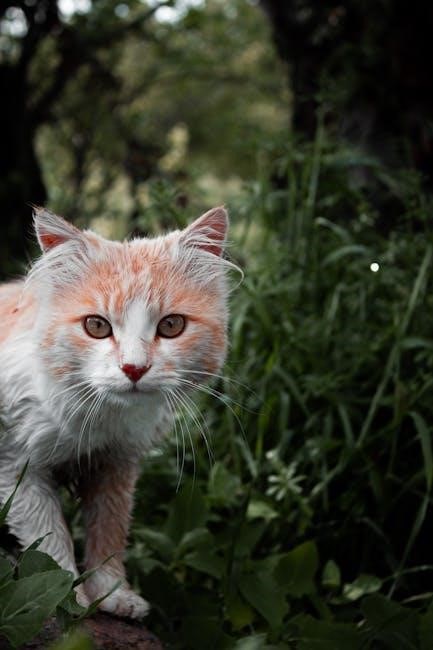
The wife’s observation of the hotel maid and the padrone highlights her own powerlessness and lack of agency. She envies the maid’s ability to connect with others and receive gratitude. Analyzing these interactions within a PDF provides a nuanced understanding of her character’s motivations and vulnerabilities, revealing a woman trapped in a cycle of disappointment.

XV. The Wife’s Yearning and Isolation
The wife’s profound yearning and resulting isolation are central to “Cat in the Rain,” and a PDF version of the story facilitates a focused examination of these themes. Her desire for a cat isn’t simply about wanting a pet; it represents a deeper need for companionship and something to nurture, a void in her life.

Through careful annotation within a PDF, one can trace the subtle cues indicating her unhappiness. Her repeated attempts to engage George, coupled with his dismissive responses, underscore her emotional detachment. The rainy setting amplifies her sense of loneliness, creating a palpable atmosphere of despair.
The story’s minimalist style, easily appreciated when studying a PDF, emphasizes the wife’s internal state. Hemingway’s sparse prose forces the reader to infer her feelings, highlighting the unspoken tensions within the marriage. Her fascination with the cat and the hotel maid reveals a longing for connection and a sense of belonging, tragically unfulfilled.
XVI. The Wife’s Relationship with George
Analyzing the dynamics of the wife’s relationship with George is crucial to understanding “Cat in the Rain,” and a PDF format allows for detailed textual examination. Their connection is characterized by a distinct lack of genuine communication and emotional intimacy, presenting a portrait of marital stagnation.
Within a PDF, one can readily highlight George’s consistent detachment and indifference towards his wife’s desires. He prioritizes his own activities – reading and drinking – dismissing her attempts at conversation and connection as trivial. His focus remains firmly on himself, leaving her feeling unseen and unvalued.
The story’s subtle nuances, easily observed when studying a PDF, reveal a power imbalance within the marriage. George’s controlling behavior, manifested in his dismissive attitude, contributes to the wife’s sense of isolation. The cat becomes a symbol of her unmet needs and her husband’s inability or unwillingness to fulfill them, a poignant commentary on their fractured relationship.
XVII. Character Analysis: George
George, in Hemingway’s “Cat in the Rain,” is a study in masculine detachment, a character best analyzed through close reading facilitated by a readily accessible PDF version of the story. He embodies a certain post-war stoicism, bordering on indifference, towards his wife’s emotional needs and desires.
A PDF allows for easy annotation of George’s dialogue and actions, revealing a pattern of dismissiveness. He consistently avoids engaging with his wife on a deeper level, preferring to focus on his own pursuits. His curt responses and lack of empathy highlight a significant emotional distance between the couple.
Examining the text within a PDF format underscores George’s pragmatic nature. He views his wife’s fascination with the cat as frivolous and inconsequential, failing to recognize it as a manifestation of her deeper longing for connection and fulfillment. His character serves as a foil to his wife’s yearning, emphasizing the communication breakdown at the heart of their marriage. He represents a generation grappling with the aftermath of war, perhaps emotionally stunted by its trauma;

XVIII. George’s Detachment and Indifference
Analyzing George’s detachment and indifference is significantly enhanced by utilizing a digital PDF copy of “Cat in the Rain,” allowing for focused textual examination. His behavior isn’t overtly cruel, but rather characterized by a pervasive emotional unavailability, a subtle yet potent form of neglect.
The PDF format facilitates tracing instances where George dismisses his wife’s feelings, often responding with minimal effort or redirecting the conversation. He shows little interest in her desire for a cat, viewing it as a childish whim rather than a symbolic expression of her loneliness. This indifference is particularly striking given her evident emotional vulnerability.
Through careful study within a PDF, one can observe George’s preoccupation with appearances and maintaining a sense of control. He seems more concerned with how things seem than with his wife’s actual emotional state. His detachment can be interpreted as a symptom of the post-war disillusionment, a difficulty in forming genuine connections. The story, readily available as a PDF, powerfully illustrates the isolating effects of emotional distance within a marriage.
XIX. The Hotel Maid and the Padrone
A PDF version of “Cat in the Rain” allows for a detailed examination of the roles played by the hotel maid and the padrone, figures crucial to understanding the story’s themes. The maid represents a practical, grounded connection to the local culture, contrasting sharply with the American couple’s alienation.
Studying the text within a PDF reveals the maid’s willingness to engage with the wife’s desire, ultimately procuring a cat from the padrone. This act of kindness, though seemingly small, offers a moment of genuine connection that George fails to provide. The padrone, though unseen, is the source of the cat, symbolizing a different kind of authority and generosity.
The PDF format enables close reading of the dialogue, highlighting the maid’s simple yet empathetic communication. Her offering of the cat, “from the padrone,” is presented as a straightforward gesture, devoid of the emotional complexity that characterizes the couple’s interactions. Analyzing this scene through a PDF underscores Hemingway’s exploration of communication barriers and the search for meaning in a fragmented world.
XX. The Gift of the Cat: A Symbolic Act
A PDF of “Cat in the Rain” facilitates a focused analysis of the cat as a potent symbol, particularly the act of gifting it. The cat, delivered by the hotel maid “from the padrone,” isn’t merely a pet; it represents a potential fulfillment of the wife’s unspoken desires for connection and perhaps, motherhood.
Examining the scene within a digital PDF allows for repeated readings, emphasizing the wife’s immediate and enthusiastic acceptance of the cat. This contrasts with George’s dismissive attitude, highlighting his emotional distance. The PDF format aids in tracing the symbolic weight of the gift, suggesting a temporary alleviation of her loneliness.
Through the PDF, one can dissect Hemingway’s deliberate ambiguity. Is the cat a genuine gesture of empathy, or simply a convenient way for the hotel staff to appease a guest? The story’s open-endedness, easily navigated within a PDF, invites readers to interpret the act as a complex representation of longing, displacement, and the elusive nature of happiness.
XXI. Analyzing Hemingway’s Use of Imagery
A digital PDF version of “Cat in the Rain” is invaluable for dissecting Hemingway’s masterful use of imagery. The story’s evocative descriptions – the rain, the gardens, and the sea – create a pervasive atmosphere of melancholy and isolation, readily observable when studying the text in a focused PDF format.
The PDF allows for close reading of passages detailing the “dripping palms” and “empty square,” emphasizing the sense of monotony and abandonment. These images, combined with the relentless rain, mirror the wife’s internal state of yearning and dissatisfaction. Annotating a PDF enables highlighting recurring motifs and tracing their symbolic resonance.
Furthermore, the war monument, repeatedly mentioned, gains significance when examined within the PDF’s context. Its presence underscores the story’s subtle exploration of post-war disillusionment. The PDF format facilitates comparative analysis, revealing how Hemingway’s imagery contributes to the story’s overall themes of dislocation and failed communication.
XXII. Rain, Gardens, and the Sea
Examining a PDF of “Cat in the Rain” reveals how Hemingway intricately weaves rain, gardens, and the sea into the narrative’s emotional core. The persistent rain isn’t merely weather; it symbolizes the wife’s sadness and unfulfilled desires, a point easily traced when studying the text digitally.
The public gardens, viewed from the hotel window in the PDF, represent a controlled, artificial beauty, contrasting with the wife’s longing for something more authentic. The sea, a vast and potentially liberating force, remains distant and unattainable, mirroring her emotional distance from George. A PDF allows for repeated, focused examination of these settings.
Annotating the PDF highlights how Hemingway uses these elements to create a sense of monotony and abandonment. The “regular waves on the beach” become a symbol of cyclical, unfulfilling routine. The interplay between these images, readily apparent in a digital format, underscores the story’s themes of isolation and the search for meaning.
XXIII. “Cat in the Rain” as a PDF: Accessibility and Study
The availability of “Cat in the Rain” as a PDF significantly enhances its accessibility for students and scholars alike. Digital formats remove barriers to access, allowing for widespread study of Hemingway’s concise masterpiece. A PDF version facilitates convenient reading on various devices, promoting engagement with the text.
For academic purposes, a PDF allows for easy annotation, highlighting key passages, and note-taking directly within the document. This interactive approach deepens comprehension and encourages critical analysis of Hemingway’s stylistic choices and thematic concerns. Studying the story in this format streamlines research and essay writing.
Furthermore, PDFs are easily shareable, fostering collaborative learning and discussion. The ability to quickly reference specific sections and share insights with peers makes the PDF an invaluable tool for literary study. The story’s brevity, combined with the convenience of a PDF, makes it an ideal text for classroom analysis and independent exploration.